Bats, birds and tree work in Exeter gardens
Garden trees in Exeter often shelter birds and bats, and some of those animals are protected by law whether or not the tree itself is protected. Cutting, pruning or felling a tree without checking for wildlife can lead to an offence, and it can also stop a job in its tracks once a crew finds an active nest or a roost. This guide explains which species are most often found in urban trees, when a survey is needed, how seasonal timing affects the programme and what an owner should expect from a contractor who takes wildlife seriously.
Common urban species in garden trees
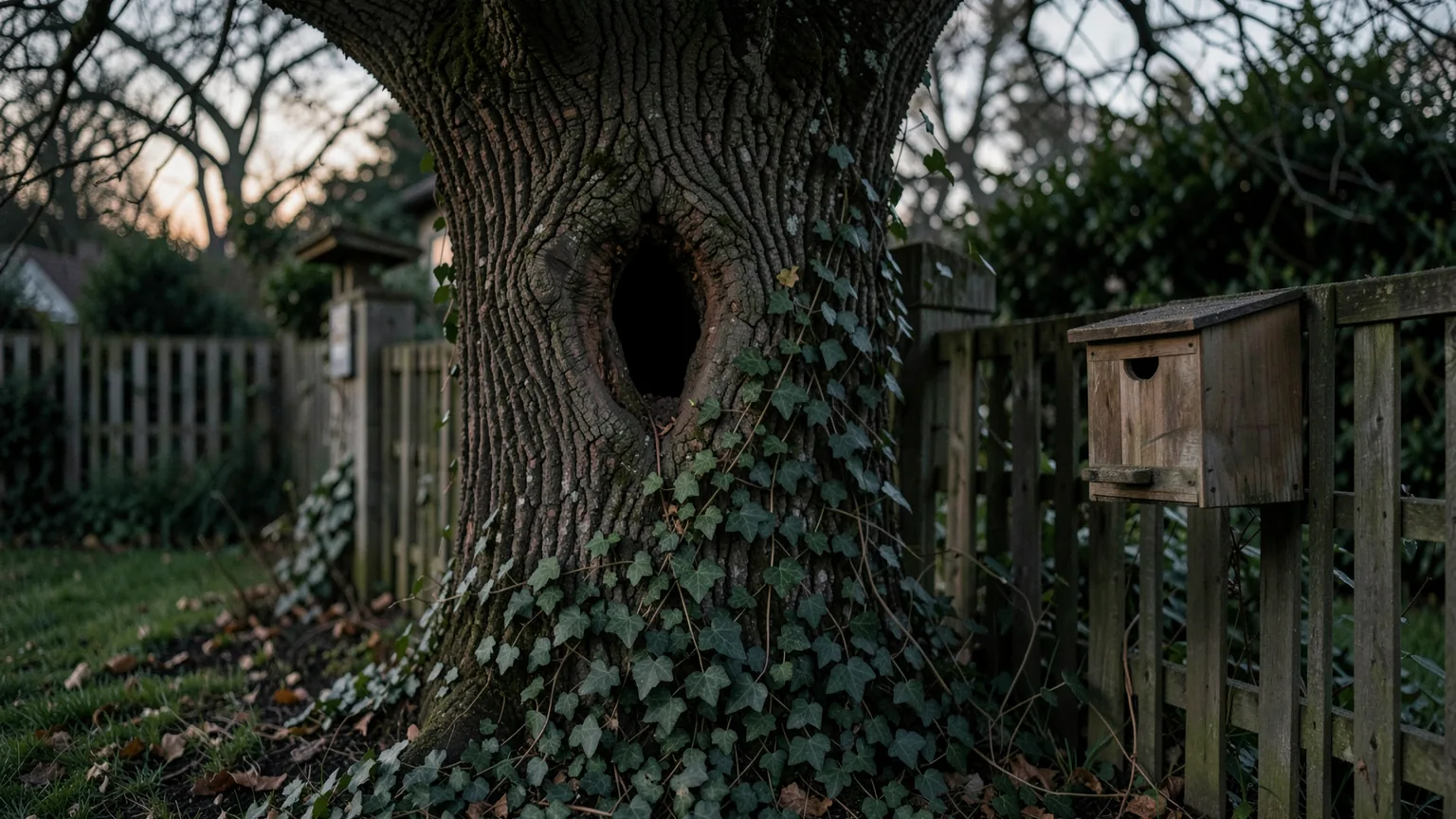
The species most likely to be found in an Exeter garden tree are common birds such as blackbirds, robins, wrens, tits and starlings. Larger trees, particularly older specimens with cavities, can also host bats, and several species roost in holes, splits and loose bark. Bats are less often seen than birds because they are active at dusk and their roosts are usually hidden. A tree with a lot of ivy, a broken limb or a woodpecker hole can be worth checking more carefully than a neat, well-kept specimen.
Protection applies regardless of how common the species is. Under the Wildlife and Countryside Act 1981, it is an offence intentionally to take, damage or destroy the nest of any wild bird while the nest is in use or being built. A separate offence of intentionally or recklessly disturbing a bird while it is building a nest, or while it is on or near a nest containing eggs or young, applies only to the specially protected birds listed in Schedule 1 to the Act. Under section 21, these offences can lead on summary conviction to up to six months' imprisonment, a fine, or both. Bats are protected under the Conservation of Habitats and Species Regulations 2017, which protect bats and their breeding sites and resting places. Those rules apply to ordinary garden work, not only to large development schemes.
Hedges and shrubs under the tree deserve the same attention. Dense ivy, holly and thick hawthorn often hold nests that are missed when the crown is inspected from the ground, and a crew that clears the lower growth first may disturb birds that were using it. Walking the full height of the tree, from the base of the stem to the outer twigs, before any cutting starts is the simplest way to see what is actually there.
When a survey is needed
A survey is needed when a tree is likely to contain a roost or a nest, or when the work would affect habitat that protected species use. In practice, most garden tree work does not need a formal bat survey, but a competent contractor will look for signs before cutting, and will stop and take advice if it finds evidence of a roost. Signs of bats include droppings at the base of the trunk, staining around cavities, a distinct smell and the presence of insects around a split. Birds leave signs of nesting in the crown during the breeding season.
Where planning permission is involved, the government's advice on bats and planning decisions explains when a survey must be commissioned and what it should cover. The guidance describes a survey as needed where a development proposal is likely to negatively affect bats or their roost, foraging or commuting habitats, which means a tree that forms part of a commuting route can be relevant even if it is not itself a roost. An ecologist who is familiar with the industry guidance on bat surveys is the right person to make that assessment.
Surveys are time-limited. A survey carried out in one season does not always give the answer for another, and bat activity changes through the year. A surveyor will say which season is appropriate and how long the results are likely to remain valid. Owners should ask for that information early, because a survey that is booked too late can push the whole programme back.
Seasonal timing and the nesting season
The nesting season is the period when birds are most likely to be building nests, incubating eggs or raising young. It runs from the spring into the late summer, and in practice many contractors avoid cutting trees during this window unless they have checked for nests immediately beforehand. The rule in the Wildlife and Countryside Act does not set a fixed calendar, so the key test is whether a nest is in use or being built on the day the work is carried out.
This is where timing and programme meet. A reduction planned for early summer may need to be checked on the morning of the work, and a crew may have to stop if a nest is discovered. Owners who want to avoid delay can schedule necessary work in the dormant season, which is generally late autumn into winter. The compliance service can prepare a site check and a programme that avoids conflicts with nesting birds and bat activity.
Impact on the programme
A wildlife find can affect a job in several ways. If an active nest is found, the affected branch or tree must be left until the young have fledged, which may mean a short wait or a change to the method. If a bat roost is found, the work may need to stop until a licence is in place or the roost has been assessed. Natural England issues the licences for bats in England, and the process takes time, so an owner who discovers a roost in the middle of a planned job should expect a delay.
The most effective way to limit this impact is to plan for it. A contractor who builds a wildlife check into the programme, with a pre-work inspection and a clear procedure for stopping and taking advice, will minimise disruption. A contractor who does not mention wildlife at all may not have considered it, and an owner should ask how it will be handled before the work is booked.
What an owner should expect from the contractor
A responsible contractor will look for wildlife signs before work begins, record what it finds and explain how it will proceed. Its climbing and rescue plan should follow the approach in the guide on work at height and chainsaw rules, so that a pause for wildlife does not leave a climber stranded in the crown without a plan. It will not cut a tree with a visible nest, and it will not attempt to remove a bat roost without the appropriate advice and licence. It should be willing to show its procedure in writing and to explain how it would respond to a discovery. If the work is in a sensitive area or involves a larger tree, it should recommend an ecologist's survey where appropriate.
Owners can help by telling the contractor about any known wildlife, such as a long-established nest, a bat box, or a pond that attracts amphibians near the tree. Local knowledge is valuable. Owners in Alphington, Pennsylvania or Exwick will often know which trees are used by birds or bats, and that information helps the contractor plan the job around the animals rather than discovering them mid-task. Photographs of the tree taken in early summer, when the crown is full, add a useful record: they show nests that are hard to see from the ground and make it easier to compare the tree from one visit to the next. A standard tree service visit that starts with this record usually moves faster once the crew is on site.
Local ecology and good practice
Exeter's gardens, parks and trees provide habitat for a wide range of species, and the timing of any work is one of the simplest ways to keep disturbance low. A job that is planned around the nesting period and the bat activity of the season is less likely to be stopped partway through, and the trees along the river corridors and older streets can be particularly valuable. Good practice goes beyond the legal minimum. Retaining deadwood where it does not present a risk, leaving cavities intact where possible and keeping a dense hedge or shrub layer below the crown all help wildlife. An arborist who understands these points can often recommend a reduction that meets the safety need while keeping the habitat value.
A quote request that mentions the wildlife concerns and the tree's position gives the contractor what it needs to plan the programme sensibly from the start.
Sources and further reading
- Wildlife and Countryside Act 1981, section 1: protection of wild birds, their nests and eggs (legislation.gov.uk)
- Wildlife and Countryside Act 1981, section 21: penalties (legislation.gov.uk)
- The Conservation of Habitats and Species Regulations 2017 (legislation.gov.uk)
- Bats: advice for making planning decisions (GOV.UK)