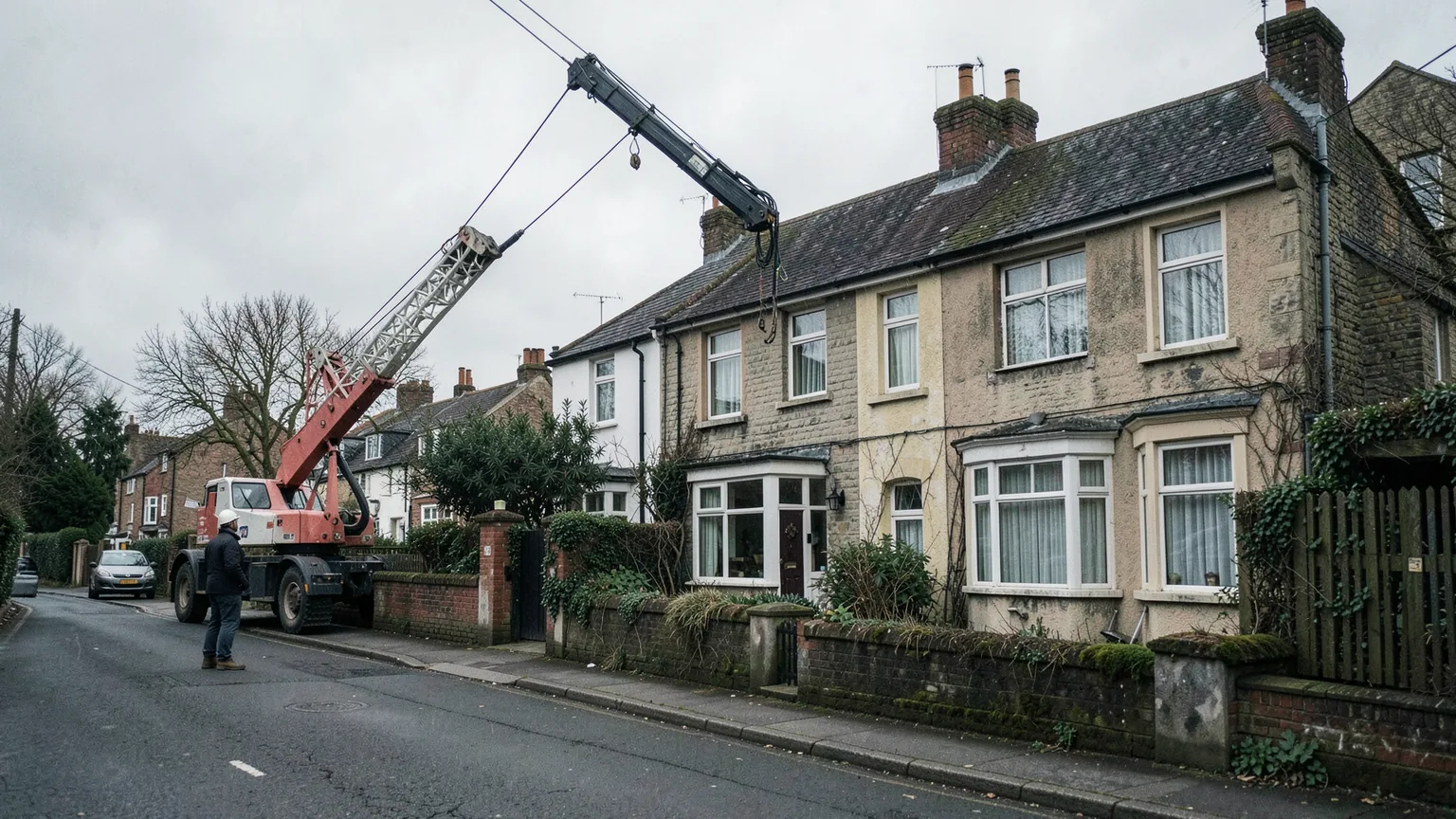
Why some Exeter trees need a crane
Some tree work in Exeter needs a crane because the tree cannot be safely reached or dismantled from the ground or by climbing alone. A crane is not the default for every large tree. It is brought in when the position of the tree, the size of the sections to be lowered or the surroundings make a rope-and-harness approach unsafe or impractical. Understanding why a crane is needed helps an owner read a quote sensibly, because access is one of the biggest drivers of cost and most of the difference between a straightforward job and an expensive one comes down to the site rather than the tree.
When climbing or ladders are not possible
Climbing and ladder work are the usual methods for pruning and felling in gardens. They work well when the tree is reachable, the sections are small enough to lower by rope and there is room to set up a safe working position. The difficulty starts when a tree stands behind a house, over a conservatory or between two garages with no clear route for a team on foot. In those cases the crew cannot place an anchor point, cannot control falling wood and cannot retrieve the sections without damaging the structure around them.
Ladders have their own limits, and a ladder placed against a trunk or leaning into a crown is rarely a suitable working platform for a large tree. The Work at Height Regulations 2005 require that work at height is properly planned, appropriately supervised and carried out as safely as is reasonably practicable, including the selection of equipment. When a tree cannot be worked from a secure position, a crane or an elevated platform is often the only way to meet that duty.
Trees that lean over buildings, that have a weak union high in the crown, or that sit on a steep bank are typical examples. So are trees with a dense mass of branches that would need to be dismantled piece by piece from above. In each case the crane allows the team to lift the sections out rather than lower them through the gap at ground level.
Crane and platform hire
A crane is usually hired with an operator and a lifting supervisor, and the work is planned around the lifting plan. The Lifting Operations and Lifting Equipment Regulations 1998 apply to lifting equipment, including cranes. The Health and Safety Executive's brief guide on lifting equipment at work explains what equipment falls within the regulations and summarises what they require, including the planning and supervision of lifting operations and the examination and inspection of the equipment. For a tree contractor, the practical consequence is that a crane must arrive with its paperwork and that the lift must be planned, not improvised on the day.
Aerial platforms are sometimes used instead of a crane for smaller trees or for work on a single side of a building. They cost less to position but reach less far, and they cannot lift heavy sections from a distance. The choice between them depends on the height and spread of the tree, the weight of the sections and the space available to set up the machine. An honest survey should say which method is proposed and why, rather than leaving the owner to guess.
Road closures and permits
A crane positioned on a public road or pavement may need a temporary restriction, and the power to make one is in section 14 of the Road Traffic Regulation Act 1984, which deals with temporary prohibition or restriction of roads. For Exeter the highway authority is Devon County Council, so a permit or closure request sits with the county rather than the city council. The county's temporary traffic restrictions page says that a road closure or a parking suspension needs a temporary traffic regulation order or notice, that it needs three months' notice, and that road closures are a last resort. A crane that swings loads over a road or pavement also needs a licence of its own: the county's crane licence page cites sections 169 and 178 of the Highways Act 1980, warns that placing the equipment before applying is an offence, and asks for a minimum of 20 days' notice. Both lead times belong in the programme from the start.
Traffic management involves signing, cones, sometimes a temporary parking suspension and in some cases a marshal to stop pedestrians and vehicles while a load is in the air. Each of these has a cost and a time element. A tree in a quiet cul-de-sac may need only a short closure, while one on a main route near a school or a bus stop may need a longer closure and more staff. Owners who ask for a crane-supported quote should expect the proposal to name the traffic arrangements separately, and should ask whether they are included or charged on top. A compliance check can confirm which permits and notices a particular street will need before the crane is booked, which avoids a closure being cancelled at the last minute.
Time and crew effects
The crane is only one part of the cost. A crane lift runs at a daily rate, and the time it takes depends on the number of lifts, the weight of each section and how quickly the crew can unhook and reposition. A team of three or four with a crane can often clear a tree in a day, while the same tree dismantled from the ground by climbers might take longer but without the hire. Access also changes the crew size, since a lifting supervisor and a ground team are needed alongside the tree climbers.
Waste handling is affected as well. When sections are lifted out over a building or a garden, they may be placed in a skip or a designated loading area, and the logistics of clearing the site need planning. The commercial tree service prices access and waste as separate items so that the owner can see where the money is going. Weather matters too. High winds stop crane work, so a programme set for a fixed week needs a contingency, and some contractors include a standby day in their timescale.
Comparing options before work starts
A sensible comparison starts with a site visit and a written method statement. The method should also say how the crane will be positioned, who holds the lifting plan and what happens if the wind rises during the lift, since those answers show whether the contractor has planned the job or is relying on improvisation. The contractor should explain why a crane is proposed, what the alternatives are and what the trade-off is between cost and risk. If a climbing crew can do the work safely with a rigging method that avoids the crane, that is a legitimate option to discuss. Equally, pushing an unsafe climbing method to save money is not acceptable, and a quote that rules out a crane for a tree that clearly needs one should prompt questions.
Owners in Exeter often have constrained sites: shared access routes in older streets, steep gardens in suburbs such as Pennsylvania and Heavitree, and tight plots in the city centre. The survey should record these constraints in plain terms, including the distance from the tree to the nearest building, the route for lifting equipment and any overhead cables. A quote request that includes photographs and the access route allows the contractor to price the crane element realistically rather than adding a general allowance.
Where a crane is worth the money
A crane is the right choice when it reduces risk to people and property more than it adds cost. A tree that overhangs a house, a commercial premises or a busy footpath is a strong candidate, because the damage from a poorly controlled fall is much greater than the cost of a planned lift. A tree leaning across a neighbour's land is a common case, and the boundary questions it raises are covered in the guide on overhanging branches and roots in Exeter. Trees that are protected, or that stand within a conservation area, may also need a method that keeps the crown and root zone intact, and a crane can make that possible when climbing would require heavy pruning to clear a route.
Access drives cost more than the height of the tree. An owner who understands that point is better placed to ask the right questions, compare like with like and decide whether a crane-supported job is the proportionate answer for their site.
Sources and further reading
- The Work at Height Regulations 2005, regulation 4 (legislation.gov.uk)
- Lifting equipment at work (INDG290) (Health and Safety Executive)
- Road Traffic Regulation Act 1984, section 14: temporary prohibition or restriction on roads (legislation.gov.uk)
- Temporary traffic restrictions (Devon County Council)
- Placement of rails, beams and cranes over the highway (Devon County Council)