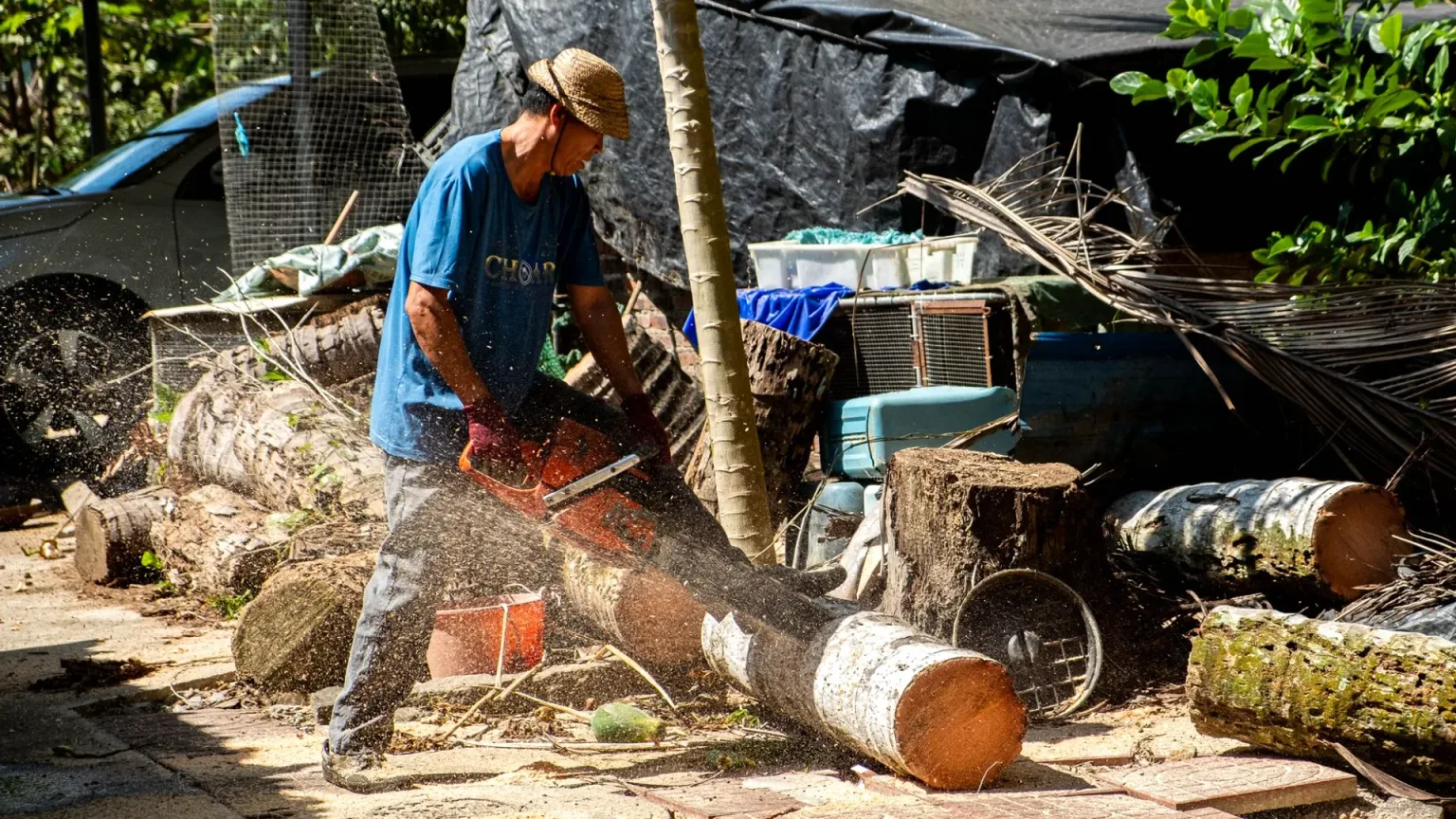
Stump grinding explained for Exeter gardens
A tree stump left after felling is not a finished job, and the owner has to decide what happens to it before the crew leaves. There are three broad choices: grind the stump down to below ground level, remove it completely with an excavator, or leave it to rot and treat the surface. Each has different costs, different consequences for the garden and different risks if the ground contains buried services. This guide explains how each option works so that the choice is made before the quote is accepted, rather than after the first attempt to clear the site.
Grinding the stump
Stump grinding uses a rotating cutting wheel that is lowered into the stump and moves across it in passes, reducing the wood to sawdust-sized chippings. The machine is normally run by a crew with a tracked or wheeled grinder, and the depth it reaches depends on the size of the stump and the length of the cutting arm. Most grinders work to a depth below the surrounding soil, so that the ground can be topped with soil and grass seed once the chippings have been cleared.
The result is a hole filled with chippings and wood fibre, which will settle over the following months. Owners should expect the surface to remain uneven for a time, and should ask whether the crew will top up the hole with soil or leave the chippings in place. Chippings from grinding are not usually suitable for the soil around fruit trees or shrubs, so the owner should say what is wanted before the work starts.
Grinding is quicker and less disruptive than removal, which is why it is the most common option for gardens. It does not, however, take out the roots that run beyond the stump, and those can continue to send up suckers or decay in the ground for years. A crew should advise on the root spread, particularly where a stump sits close to a fence, a path or a building.
Full removal with an excavator
Full removal digs out the stump and as much of the root plate as can be reached. A stump close to a wall or a fence can be pulled in the direction of the structure, so the crew should plan the lift so that the root plate does not disturb the foundations. It is usually carried out with a mini excavator, which lifts the stump from the ground and leaves a larger hole than grinding would. The method removes the source of regrowth more completely, and it is the option most often chosen where a replacement tree or a building project is planned on the same spot.
The downside is disruption. An excavator needs access wide enough to bring it into the garden, and the ground around the stump will be turned over. Lawns, patios and borders may have to be lifted or protected, and the crew will need space to stack the removed material. Owners in a terraced street or a garden with a narrow side passage should check the access before accepting a quote for full removal, because the cost of the access work can exceed the cost of the removal.
Excavation also raises the risk of hitting something buried. Pipes, cables and drains can run close to the base of a tree, and the crew should check for services before digging. The Health and Safety Executive's guidance on tree work sets out the safe working expectations for crews on site, and the same care applies to any excavation near the root zone.
Leaving the stump in place
Some owners choose to leave the stump and treat it. Stumps can be cut low, covered with a layer of soil and allowed to rot, or treated with a product that speeds the decay of the wood. Where a stump is left, the owner should be aware that some fungi produce brackets and fruiting bodies as the wood breaks down, and that a rotting stump can attract insects and small animals.
Leaving a stump is also a decision that affects the garden for years. A stump in the middle of a lawn is a trip hazard, a mower obstruction and a potential source of new shoots. A treated stump also still needs a plan for the next decade, not just the next season. If the owner later wants to build a patio, lay a drive or plant a new tree, the buried remains will need dealing with at that point, and that cost will not be in the original quote. Owners who choose this option should ask the crew to cut the stump as low as is practical and should mark its position on a plan, so that future digging does not catch it unexpectedly.
Access also shapes the choice. A grinder that can reach the stump from the lawn is quicker to set up than one that must be carried through a side passage, and an owner who has a narrow gate should measure it before the crew visits.
Waste from stump work
Stump material counts as waste from the job, and the person who produces it has a duty of care under section 34 of the Environmental Protection Act 1990. A crew removing a stump must be able to show where the material went, and an owner should expect a receipt or a transfer record for larger loads. The government's guidance on disposing of business or commercial waste describes the same principles for waste leaving a premises, and it is a useful reference for owners who are managing a commercial site.
Chippings from grinding are a separate issue. They can be kept on site as mulch, taken away in a skip or taken to a tip, and each option carries its own rules and costs. The guide on recycling logs and chippings sets out the lawful routes for householders in the city.
Grinding also produces a different waste profile from removal. Ground stumps yield fine, fibrous chippings that can be spread thinly as mulch on paths and beds, whereas a removed stump yields solid wood and soil that may need to be taken away. That difference matters for the disposal route and for the cost. Owners in Exeter who ask for both options should expect each quote to say which waste stream it creates.
Planning the removal of a stump
Start by working out what the stump is for. If the owner plans to replant in the same place, full removal may be worth the extra cost. If the stump is in an area that will be paved or built over, removal is normally needed. If the stump is well away from anything else and the owner does not mind a level but slightly raised surface, grinding is usually the simplest option.
Before a crew starts, the owner should check for buried services and should tell the crew about any features that could be damaged, such as a pond liner, a drain cover or a garden structure. A written note on the access route is also helpful, because a crew that has to carry a grinder through a house can take much longer than one that can drive a machine to the site. The what to do before a tree crew arrives guide covers the preparation steps that save time on the day.
For larger jobs, the commercial tree service covers stump removal as part of a wider programme, and the residential tree service describes the typical arrangements for garden work. A quote request that says whether the stump is to be ground, removed or left will give contractors the information they need to price the work accurately, and it avoids a return visit to clarify the method.
Exeter gardens vary a great deal in size and access, from small terraces to larger plots near Topsham and Countess Wear. The method that suits one garden may not suit another, and the choice is easiest made after the crew has seen the site.
Sources and further reading
- Tree work (Health and Safety Executive)
- Environmental Protection Act 1990, section 34 (legislation.gov.uk)
- Dispose of business or commercial waste (GOV.UK)